
What is an arteriovenous malformation (AVM)?
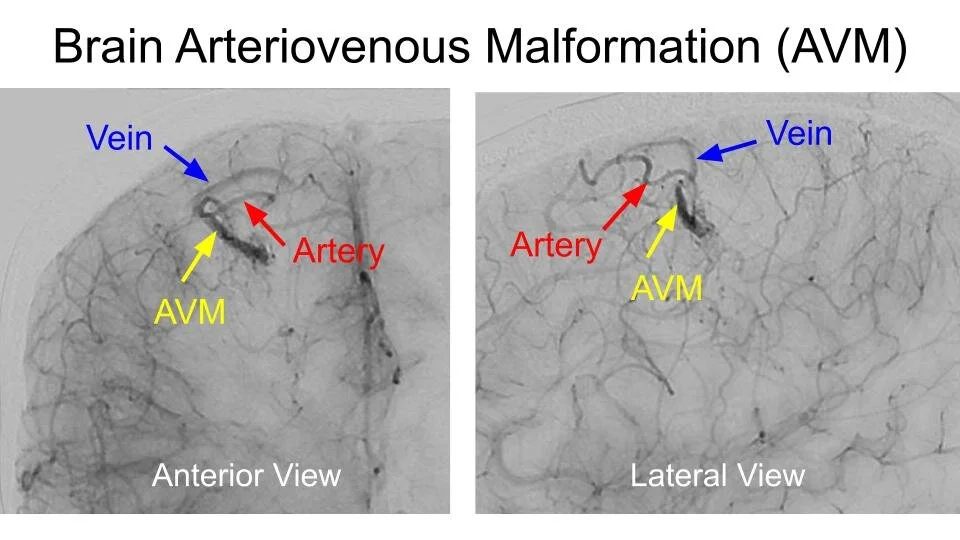
An arteriovenous malformation (AVM) is an abnormal tangle of blood vessels in which an artery connects directly to a vein rather than to an intervening set of tiny blood vessels called capillaries. They can occur in many parts of the body, including the brain.
Why do AVMs hemorrhage?
AVMs alter the flow of blood within the brain, and they carry a risk of hemorrhage. Arteries and veins are two types of blood vessel that have different strengths and elasticities. Blood pressure in an artery is normally much higher than in a vein. If an artery connects directly to a vein, the walls of the vein may weaken over time. If the walls weaken enough, they can burst.
What are the symptoms?
Symptoms from AVMs vary depending on the size, location, and blood flow pattern. If an AVM bleeds, a patient can develop stroke-like symptoms, including headache, weakness, visual changes, speech problems, and lethargy, among others. AVMs may also cause recurrent seizures (epilepsy), similar to a phenomenon seen with cavernous malformations.
Do all AVMs need treatment?
Most AVMs are thought to be congenital, meaning that they are present at birth. Some are quiet for years and never cause symptoms. Others are large or prone to hemorrhage. Most AVMs need either treatment or close monitoring. Even if the annual hemorrhage risk of an AVM is judged to be relatively low, this risk compounds over a lifetime, especially for young patients.
How are AVMs treated?
The goal of AVM treatment is to close off the abnormal connection between the artery and vein. This can be accomplished using a craniotomy or Gamma Knife radiosurgery. Choosing between these therapies requires a careful review of the location and flow pattern of the AVM. Patients need a special study called an angiogram to help guide the treatment strategy.
My guide to craniotomy for brain tumor or lesion and my Gamma Knife patient guide describe those procedures in detail.
Should I meet with you?
If you live near Denver and have a brain AVM, please consider meeting me in consultation to learn about treatment options.