

This information is intended as a general guide for my patients, and if you are seeing a different surgeon, it should not substitute for advice, guidance, or instructions from that surgeon.
Introduction
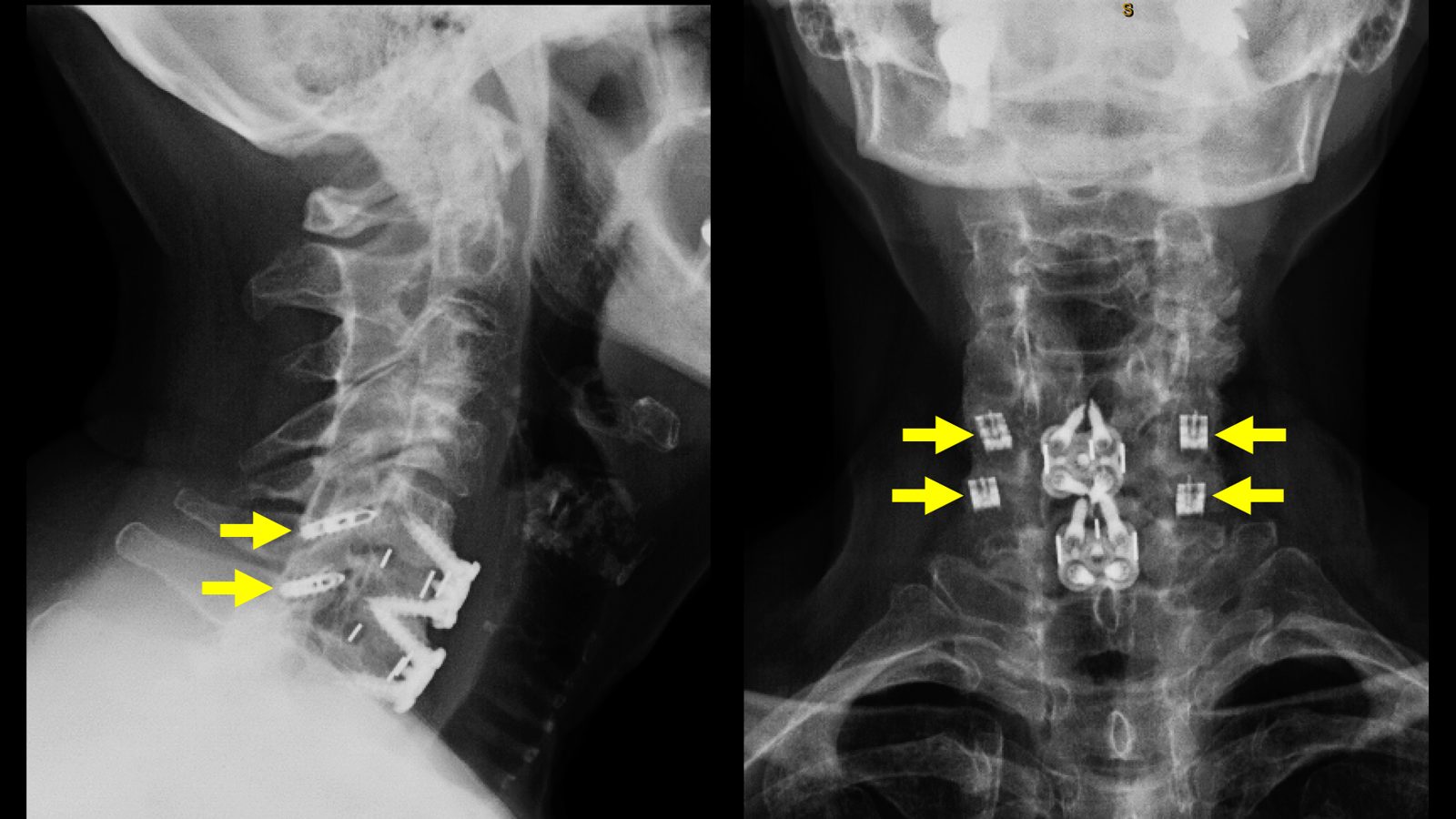
CORUS is a minimally invasive system for performing a posterior cervical (neck) fusion. A fusion encourages two or more bones in the spine to grow together (“fuse”) so that the spine is stable.
The technique does not require an extensive open incision or screws and rods in the neck. Instead, tiny cages are inserted through the skin into the facet joints of the spine (the small joints on the back of the spine) using one or two short incisions at the base of the neck.
CORUS is sometimes performed together with an ACDF and sometimes on its own. It can be used as a supplement to an ACDF for patients who have spinal instability, poor bone quality, or who need treatment at multiple levels. It can also be used to treat pseudoarthrosis (a failure of the bones to fuse) after an ACDF, to support other conventional forms of posterior cervical fusion, or to relieve ongoing pinched nerve symptoms after a prior ACDF or cervical disc replacement. This guide applies whether or not you are also having an ACDF. If you are, please also read my ACDF guide.
A distinct advantage of CORUS is that it increases foraminal height (the height of the openings where the nerves leave the spine). This can help decompress nerve roots and reduce symptoms of cervical radiculopathy without the need for an open exposure, drilling, or a laminectomy. CORUS is less invasive than a conventional posterior cervical fusion.
What to expect from surgery
- CORUS is performed under general anesthesia (i.e. asleep).
- The surgery generally takes less than 1 hour, plus setup time in the operating room.
- CORUS is usually performed as an outpatient, meaning no overnight hospital stay is required.
- Risk factors for a pseudoarthrosis/non-fusion include smoking, osteoporosis, diabetes, and having three or more levels treated. We will discuss any that apply to you before your surgery.
- Many symptoms begin improving immediately after surgery, but some may take longer than others. Symptoms generally respond on a time scale proportional to how long they were present before surgery.
- I usually provide patients a rigid neck collar/brace to wear after surgery, but this depends on your particular clinical situation. I will discuss with you a specific recommendation for whether you need a brace and for how long you should wear it. I recommend wearing it when you are up and about (e.g. walking or when there is potential to fall). Unless I specify otherwise, you do not need to wear it when sleeping or showering.
Instructions before surgery
- If you take a blood thinner such as aspirin, Plavix, warfarin (Coumadin), Eliquis, Xarelto, Lovenox, or fish oil supplements, make sure you have confirmed with me when to stop the medication before surgery.
- Do not have anything to eat or drink after midnight on the night before your surgery. Do not have breakfast on the day of surgery. Small sips of water with your pills are OK.
- Be prepared to go home after surgery.
- Please call my office with any questions.
Post-op care
Wound care
- I use dissolvable sutures, so your stitches do not need to be removed. I cover the skin with a thin layer of glue that will flake off over two weeks or so.
- You may shower the day after your surgery. Normal shampoo and soap are fine to use. Do not scrub or rub the incisions too hard. Instead, let the soapy water run over them, and then pat them dry. While showers are OK, please do not take baths or go swimming until after your wound check appointment.
- Please do not apply any ointments or creams to your incisions. The best way for them to heal is to leave them clean, dry, and open to the air.
- You will have a wound check in my office roughly 2 weeks after surgery. If you live far away and the incisions are healing well, a video visit is an option.
Medications
- If you take blood thinners such as aspirin, Plavix, warfarin (Coumadin), Eliquis, and so on, please remember to discuss with my team how soon you should restart them after surgery. Most of these drugs are safe to start 1 week after surgery.
- You will be discharged with a short course of prescription medication for pain control. You do not have to take this medication unless you need it. Over-the-counter alternatives like Tylenol and Motrin are fine to use, too (though please avoid aspirin, initially). Most patients do not need prescription medication for more than a week or so.
Activity
- If I have recommended a neck collar/brace, wear it as I have directed (see above).
- You can resume most of your day-to-day activities immediately after surgery. The exception is activities that involve straining - things like lifting heavy objects (anything much heavier than a gallon of milk) and exercise. You should wait 4-6 weeks before these activities, and begin them gradually.
- You can return to work whenever you feel ready. For desk jobs, I recommend waiting 5-7 days and then resuming work at your own pace. For physical jobs that require heavy lifting, you may need to take off at least 4-6 weeks.
- You can drive when you and your family agree you are ready. At a minimum, you will need to be off any prescription opioid medications. I recommend driving with a family member in the neighborhood at first before venturing out by yourself.
When to call my office
Please be vigilant in the first few weeks after surgery. Notify my office if you develop any of the following:
- Fever higher than 101.5°F.
- Drainage from your incisions or any other concerning incision issues. A little redness and tenderness is normal immediately after surgery, but it should get gradually better, not worse.
- New neurologic symptoms that were not present before surgery: weakness, numbness, etc.
If you are experiencing a medical emergency, please call 911.
For questions or concerns that are not a medical emergency, you can reach my medical assistant directly at (720) 599-3075 or MDMian@carepointhc.com. You can also call the CarePoint Neurosurgery main line at (303) 515-2320.
If you or a family member is considering CORUS cervical fusion and has not yet met with me, please consider meeting me in consultation to learn more about your treatment options.