

This information is intended as a general guide for my patients, and if you are seeing a different neurosurgeon, it should not substitute for advice, guidance, or instructions from that surgeon.
Introduction
Trigeminal neuralgia (TN) is a facial pain disorder in which there are excruciating zaps of pain on one side of the face. These zaps can feel like an intense stab or shock. Attacks are often brief and without warning. Triggers may include touching the face, talking, chewing, shaving, applying makeup, or even a light breeze. Over time, the attacks may become more frequent, and some patients develop constant pain.
Historically, TN has been regarded as one of the most painful conditions known to man. TN can be a challenging diagnosis, not only due to the severity of the pain, but also the uncertainty of when an attack will occur. The disorder is often misdiagnosed; many patients have had unnecessary dental work or sinus surgery in misguided efforts to correct the problem.
Fortunately, when properly diagnosed, TN is often very treatable with both medications and with surgery. Most patients can achieve long-term freedom from pain.
What causes trigeminal neuralgia?
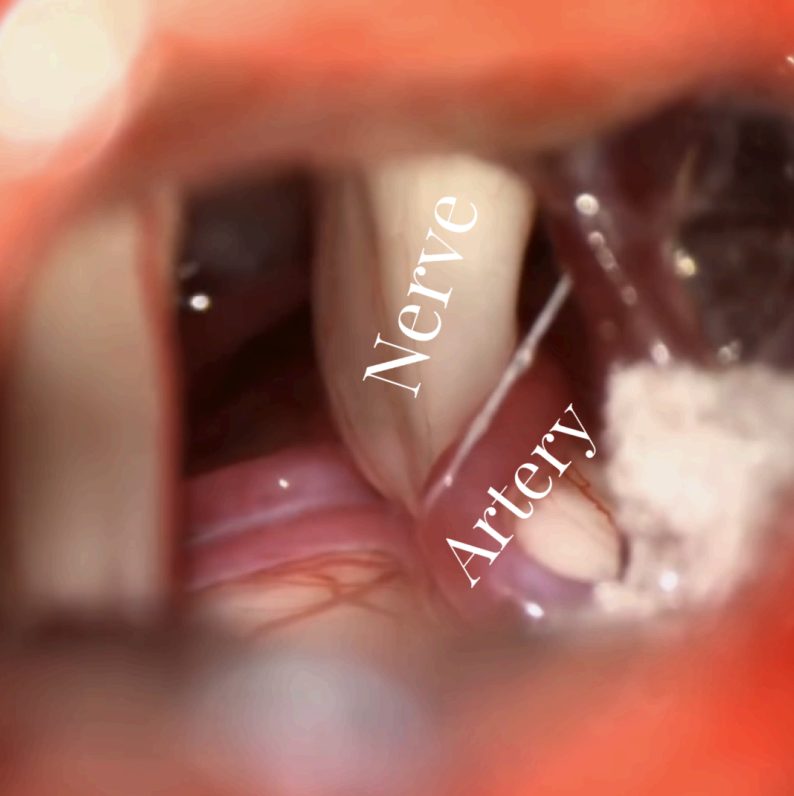
TN is generally caused by irritation of the trigeminal nerve, most commonly by a nearby blood vessel that compresses it (example photo below). The trigeminal nerve supplies sensation to the face. When it becomes irritated or injured, it may misperceive normal sensations as painful, sending signals back to the brain that the face is being stabbed or shocked.
In about 10% of TN cases, irritation of the trigeminal nerve is related to something other than a blood vessel (examples: multiple sclerosis, brain tumor, stroke, etc.).
How is trigeminal neuralgia diagnosed?
TN is diagnosed after a careful review of your symptoms and a physical examination. There is no blood test or imaging study to diagnose trigeminal neuralgia. I will order a special MRI of your brain, but this is to help plan treatment and to establish whether there is an alternate cause for your TN (e.g. multiple sclerosis, brain tumor, etc.).
Importantly, your MRI does not confirm or refute that you have TN. Consider seeking a second opinion if your doctor tells you that you do not have TN or that surgery is not an option because your MRI “is normal” or that it “does not show a vessel.” In my experience, many MRIs for TN are interpreted incorrectly.
My symptoms are different from what you described above. Could I still have TN?
Possibly. No two patients are exactly alike, and some presentations of TN are unusual. I will use your symptom history, physical exam, and MRI to investigate other possibilities. In some cases, I may recommend an evaluation by a dentist, oral surgeon, or ENT doctor.
I weigh several factors carefully in determining your diagnosis and treatment options. The following features could suggest that your pain is related to a facial pain disorder other than TN:
- Pain on both sides of the face
- Pain in an unusual distribution (e.g. in the throat, back of the head)
- Constant pain (rather than intermittent attacks) early in the disease course
- Burning or numbness
- Young age of onset (before 35 years)
Securing the correct diagnosis for your facial pain is important because the diagnosis dictates your treatment options. There are numerous facial pain disorders that mimic TN but are treated differently. Below are some common examples. I treat all of them.
How is trigeminal neuralgia treated?
Treatment for TN begins with medications. Medications for TN are not the same as those used for other forms of chronic pain. Opioids, for example, are not usually effective or advisable. Most TN medications are actually anti-seizure medications. Below is a list of common TN medications, sorted by level of evidence and effectiveness.
| Tier 1 (most evidence) | Carbamazepine, oxcarbazepine |
|---|---|
| Tier 2 | Lamotrigine, baclofen |
| Tier 3 | Topiramate, gabapentin, pregabalin, others |
| Avoid | Opioids |
I recommend that patients try at least two of the above medications before considering surgery for TN, and I usually require that at least one of the medications is from Tier 1. For patients who have not tried medications yet, I will initially refer you to one of my partnering neurologists (I am a neurosurgeon, not a neurologist). In most cases, I recommend that patients start with oxcarbazepine (Trileptal), which tends to have fewer side effects than the other Tier 1 drug.
When should I consider surgery?
You should consider surgery for TN when the following are true:
- You have severe pain that interferes with daily activities or enjoyment of life.
- You have tried at least two of the above medications, including either carbamazepine (Tegretol) or oxcarbazepine (Trileptal).
Is surgery for TN effective?
The good news is that the first-line surgeries for TN are very effective (details below). Most patients can achieve long-term pain remission.
What are the surgeries for TN?
There are three first-line procedures for TN: microvascular decompression, radiosurgery (e.g. Gamma Knife), and percutaneous rhizotomy. I perform each of these procedures. Deciding between them requires a thoughtful discussion with me regarding your history and symptoms, overall health, and goals.
Microvascular decompression (MVD)
Microvascular decompression (MVD) is the most effective and longest-lasting surgery for TN. It addresses the usual cause of TN, compression of the trigeminal nerve by a blood vessel, and it is the only first-line procedure for TN that does not involve intentionally damaging the trigeminal nerve. In an MVD, I make a quarter-sized opening behind the ear, identify the trigeminal nerve, and dissect it free of any compressive blood vessels. For those who are curious, I have numerous videos of MVDs posted on YouTube, Instagram, and my website.
Gamma Knife radiosurgery
Gamma Knife radiosurgery is an excellent alternative to MVD for patients hoping to avoid anesthesia or an incision. The procedure involves delivering a single, targeted dose of radiation to the trigeminal nerve. The radiation creates a minor injury in the nerve that dulls the transmission of pain signals. Gamma Knife is effective for TN, but pain relief after the procedure may take several weeks to a few months.
Percutaneous rhizotomy
Percutaneous rhizotomy has largely been replaced by the above two procedures, but I still perform it in select cases. The procedure involves inserting a needle through the cheek to damage the trigeminal nerve in one of several ways: by heating it up (radiofrequency), by crushing it with a balloon, or by exposing it to a chemical called glycerol. The procedure tends to cause facial numbness, and it has a relatively high recurrence rate, so I tend to reserve it for older patients who have failed the above two procedures.
How do the three procedures compare?
Below is a table summarizing key features of the three procedures for TN:
| Feature | Microvascular decompression | Gamma Knife | Percutaneous rhizotomy |
|---|---|---|---|
| Initial success rate | >90% | 80-90% | 80-90% |
| Timing of initial pain relief | Immediate | 2 weeks - 3 months | Immediate |
| Duration of relief (% of patients who are pain-free at 10 years) | >70% | 40-65% | 10-50% |
| Hospital stay required? | Yes, 1-2 nights | No | No |
| Long-term side effects | Usually none | Usually none | Facial numbness (often temporary) |
What are my options if the pain comes back?
TN pain can return after any of the above procedures, even MVD. The above table gives a rough estimate of average duration of pain relief, but an individual patient can fare better or worse than average.
What can be done if the pain returns? If medications are not successful, repeat surgery is an option. Any of the above procedures can be repeated, though I do not favor repeating a surgery if a patient did not find at least some success the first time it was performed. Alternatively, a patient with recurrent pain can select a different procedure. In most cases, having one of these procedures does not prevent a patient from having a different one performed in the future.
Where can I learn more about TN?
My website is an excellent resource for patients wanting to learn more about TN, other facial pain disorders, and the three procedures reviewed above. Here is a list of relevant pages from the site:
- Trigeminal neuralgia
- Facial pain disorders
- Microvascular decompression
- Gamma Knife
- Percutaneous rhizotomy
If you live near Denver and have trigeminal neuralgia or another facial pain disorder, please consider meeting me in consultation to learn about your treatment options.